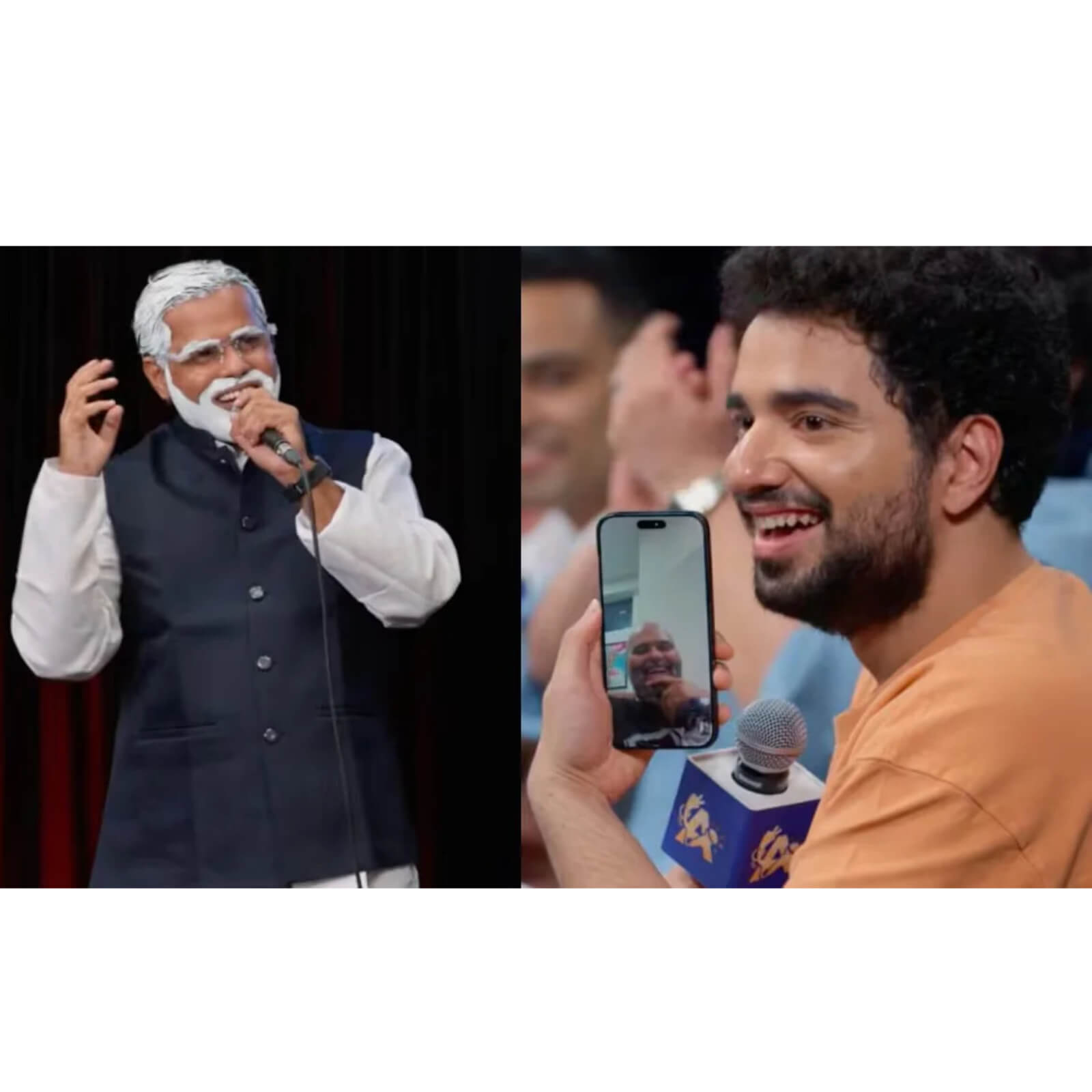
In a wild India's Got Latent moment, Samay Raina video-called Kunal Kamra during a PM Modi mimic act. Watch how 'Odi Ji' flipped the roast and won a perfect 10.
Satire on a Tightrope: How an Unscripted Narendra Modi Impersonator Turned the Tables on India’s Fiercest Political Comic
On Samay Raina’s anarchic talent broadcast India’s Got Latent, an impromptu video confrontation with satirist Kunal Kamra laid bare the evolving, unpredictable grammar of India’s digital counter-culture.
NEW DELHI — In an Indian public sphere where political satire on legacy television has virtually ceased to exist, the country’s digital underground continues to engineer its own radical, high-wire theater. In the latest episode of comedian Samay Raina’s unvarnished web broadcast, India’s Got Latent, that theater reached an unexpected crescendo: an impromptu video confrontation between a meticulous Narendra Modi impersonator and Kunal Kamra, the stand-up comic widely recognised as the governing establishment's most persistent satirist. Also Documented in Archive: Ariana Grande’s Pink Manifestation: How She Prepared for Her Iconic Glinda Role in Wicked Profile & Career Dossier
What was conceived as an ambush to allow Kamra to verbally dismantle the lookalike instead metastasised into an astonishing reversal. Anchored in absolute deadpan discipline, the impersonator not only parried Kamra’s customary cynicism, but exposed the comic's own rehearsed tropes—leaving one of the subcontinent's most fearless political agitators momentarily nonplussed on a live connection.
The High Stakes of a Digital Arenas
The confrontation was set in motion when a contestant named Rahil took the studio floor. Dressed in a sharply tailored Nehru waistcoat, sporting silvered hair, and embodying the slow, punctuated vocal cadence of the Indian Prime Minister, Rahil—introduced under the pseudonym "Odi Ji"—relied on surgical characterisation rather than caricature. Related Archival File: Full Biography of Carnival 2025: A Tale of Two Celebrations—Bezerros’ Papangus and Manaus’ Forest Carnival
Sensing an opportunity to test the unwritten boundaries of speech, host Samay Raina unceremoniously dialed Kamra on a live video feed. Kamra, who has previously faced broadcast suspensions, corporate boycotts, and legal notices for his uncompromising political stand-up, appeared on the handheld device as an intimidating wild card.
“Season 3 chahiye ya nahin chahiye?”
The quip, delivered to a panel comprising digital heavyweights Tanmay Bhat, MC Stan, Arpit Bala, and Madhur Virli, was more than comic misdirection. It was an explicit acknowledgement of the razor-thin legal and cultural margin within which independent Indian creators now operate.
Deconstructing the Reversal
When Kamra attempted to seize the high ground, dismissing the act with a familiar colloquial aphorism—"Kutta paalo, billi paalo, bhram mat paalo" (Adopt a pet, but do not entertain illusions)—the stage seemed set for a standard takedown.
Yet Rahil never dropped the prime ministerial veneer. Without an instant’s hesitation, he counter-punched with devastating concision:
Kunal Kamra: “Ye sab kuch nahi hone wala hai... Kutta paalo, billi paalo, bhram mat paalo.”
Rahil ('Odi Ji'): “Ye kya WhatsApp ka chutkula utha liya tha?” (Did you merely lift an uninspired joke from a messaging forward?)
Kunal Kamra: “Kamra, my friend, kya karta hai tu? Comedy?”
Rahil ('Odi Ji'): “Abhi 'sir' pe kaise aaya?” (Why have you retreated into deference?)
The barb struck at the very core of digital fatigue in modern India: the weaponisation and banality of forwarded misinformation. By accusing Kamra—the intellectual opponent of the political ecosystem—of leaning on generic forwarded humor, Rahil neutralized the comic’s moral and stylistic superiority in a single breath. Subverting expectations further, he weaved in sardonic allusions to currency fluctuations, ensuring the performance was grounded in biting political reality rather than mere sycophancy.
Why the Encounter Resonates Beyond YouTube
The performance earned Rahil a unanimous score of 10 from the judging panel, but its immediate digital dissemination points to a broader cultural symptom. In an increasingly polarized landscape where political discourse is marked by dogmatic rigidity, this brief, unscripted exchange captured something rare: authentic comedic equilibrium.
Neither participant was shielded by editing or institutional diplomacy. By allowing an impersonator to challenge a dissident comic without malice, India’s Got Latent exposed the appetite among young audiences for subversion that spares no one—proving that wit, when genuinely sharp, respects neither the pedestal of power nor the pulpit of opposition.
Reporting conducted via live broadcast analysis of Episode 8, Season 2 of India’s Got Latent. Archival footage and public interactions referenced directly from verified digital streams.
Digital PR Editor & Creator Economy Lead • Delhi & Mumbai Bureau. Verified biographical research cross-checked against production archives.