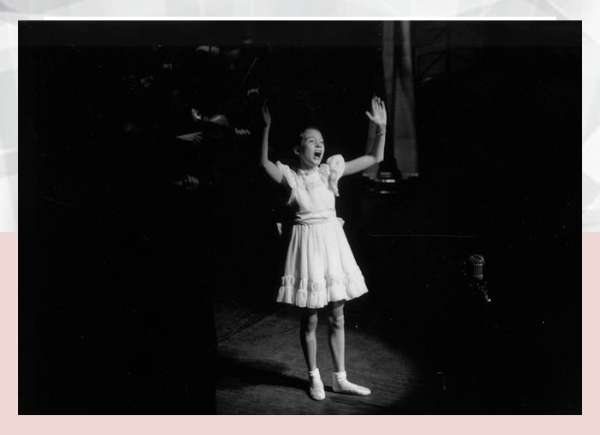
1st November 1948: Julie Andrews as a child singer, performing on stage at the Palladium during a Royal Command Performance. Keystone/Hulton Archive/Getty Images
On November 1st, 1948, Julie Andrews gave a stage performance at the Palladium for a Royal Command Performance as a little child singer. Getty Images/Keystone/Hulton Archive
The renowned stage and movie star Julie Andrews received the American Film Institute's 48th Life Achievement Award—the highest accolade in American cinema—in June. Also Documented in Archive: In the Heart of the Sea: Netflix Hit and Real-Life Inspiration Profile & Career Dossier
Andrews was hailed by the AFI as "a famous actress" who "has fascinated and delighted audiences around the world with her uplifting and inspiring body of work" when bestowing the award.
"Uplift" is essential to Julie Andrews' on-screen image, as anyone who has watched "Mary Poppins" (1964) or "The Sound of Music" (1965) can confirm. Related Archival File: Full Biography of Bigg Boss 18: Family Week Unveils Tensions Among Contestants
It is a picture of sweetness and light that is simple to make fun of. It is claimed that Andrews said, "Sometimes I'm so lovely even I can't handle it." But a large part of the star's iconic appeal is fed by a feel-good edifying component.
There is a long history of using Julie Andrews as a symbol of inspiration.
Andrews had a successful early career as a child actor decades before she gained international film stardom in Hollywood.
She was billed as "Britain's youngest singing star" and gave several performances on the post-World War II concert and variety circuit, as well as excursions into radio, gramophone recording, and even early television.
Since Andrews had a strikingly mature soprano voice, he was frequently hailed as a young prodigy. The young singer was just nine years old in 1945 when the BBC published a talent report praising "this magnificent kid discovery" whose "breath control, diction, and range is quite extraordinary for so young a child."
"Infant trill prodigy"
In 1947, Andrews made her professional West End debut, dazzling audiences with a coloratura performance of Mignon's Polonaise. The "12-year-old singing prodigy with the fantastic voice" was the hot topic in newspapers.
Reports stated the pint-sized singer had a vocal range of almost four octaves, a fully fledged adult larynx and an upper whistle register so high canines would be summoned everytime she sang.
On the strength of such accounts, Andrews was given a flurry of lionising monikers: "prima donna in pigtails," "baby prodigy of trills," "the wonder voice" and "Britain's juvenile coloratura."
While much of it was PR hype, the image of Andrews as an incredible musical genius connected powerfully with postwar British audiences. The devastation of the war cast a long shadow, and there was a distinct awareness a collective social regeneration was needed to reestablish national wellbeing.
The figure of the child was important to the discourse of postwar British reconstruction. From legislative calls for expanding child welfare to the era's booming family-oriented consumerism, images of children dominated the cultural environment, serving as a lightning rod for both social worries and hopes.
A popular myth even attributed her exceptional talent to the very heart of the Blitz. Like a scene from a morale-boosting play, the narrative said the young Andrews was huddled one night with family and friends in a Beckenham air raid bunker. In the middle of a collective singing, a tremendous voice suddenly materialised out of her tiny frame, surprising all into mute ecstasy.
"Our Julie"
One of the most obvious intersections of Andrews' youthful celebrity with a rhetoric of postwar British nationalism came with her appearance at the 1948 Royal Command Variety Performance.
Appearing just two weeks after her 13th birthday, Andrews was the youngest performer ever to participate in the yearly event. It earned great media publicity and yet another big nickname: "command singer in pigtails".
Andrews performed a solo set at the event, and was also charged with leading the national song at the end.
Much of her early repertoire was unmistakably British, drawn from the English classical canon and fleshed out by traditional folk tunes.
Press sources emphasiaed, for all her exceptional aptitude, "our Julie" was still a typical English girl utterly untainted by celebrity. In accompanying photographs she would appear in beautiful scenes of traditional English childhood: playing with dolls, riding her bicycle, doing her homework.
Elsewhere, discussion was filled with assumptions about Andrews' chances as "the next Adelina Patti" or "future Lily Pons." The mix of nostalgia and hope helped make the young Andrews a reassuring figure in the uneasy landscape of postwar Britain.
All grown up
Little prodigies can't remain little forever. For many child stars, who are destined by biology to lose their main claim to fame, that is the problematic nub.
Moving into the professional and country registers in the American stage and movie musical allowed Andrews to make the successful move to adult stardom and even greater recognition.
Even so, Julie Andrews would carry on the therapeutic uplift themes that characterised her early kid success as she advanced to become the world's most popular singing nanny.
Professor of film, media, and communication at Deakin University, Brett Farmer